Explainer
How a carrier unlock actually works
Published September 2, 2026. Updated September 3, 2026.
A carrier lock is not a setting you flip. It is an IMEI restriction. The radio asks the network whether this handset is allowed on that SIM.
If the screen says SIM Not Supported, start on Fix iPhone SIM Not Supported. Brand paths cover unlock an iPhone from its carrier and unlock a Samsung from its carrier.
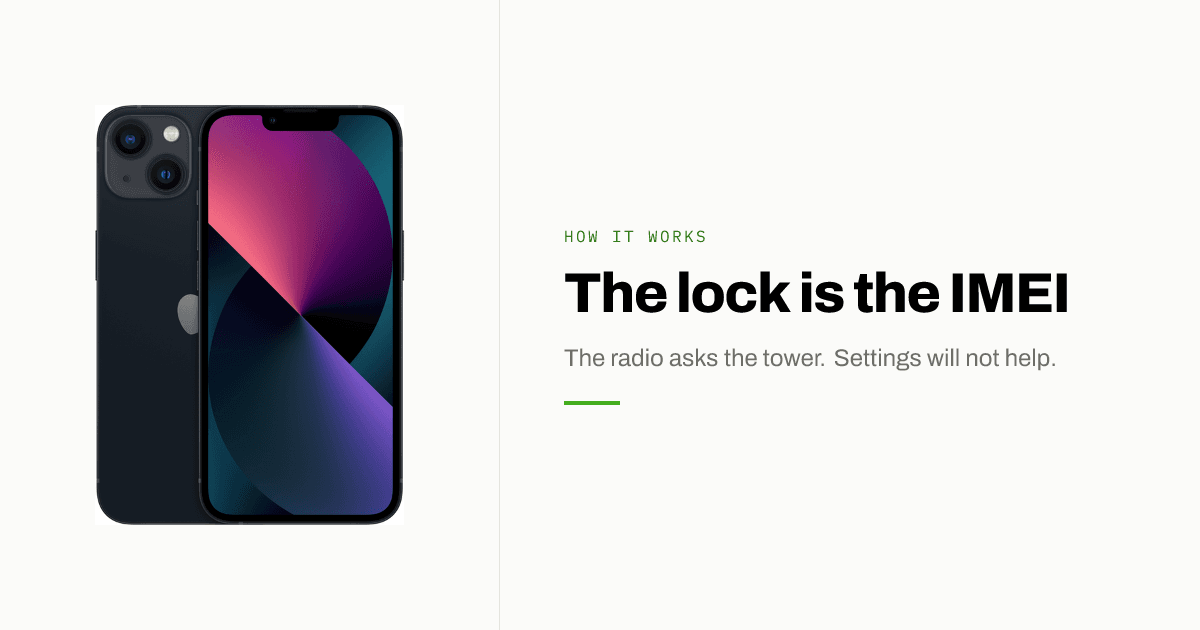
What a carrier lock is
The prepaid shop sold the phone cheap because the line was the product. The radio was told to accept that brand's SIM and refuse others. That instruction lives on the IMEI, not in an app.
You can update iOS or Android and still see SIM Not Supported. The operating system is not the lock. The modem is.
IMEI and the tower
Dial *#06#. That 15-digit IMEI is the record the carrier keeps. When a SIM attaches, the tower checks the number against a list. Allowed, the call goes through. Blocked, you get the error screen.
Find My, factory reset protection, and a Google account lock are different problems. Those are not carrier unlocks. Mixing them wastes a day.
iPhone and Android
Both send an IMEI. Apple does not give you a useful unlock toggle in Settings. Samsung One UI can look like a software fault while the radio is the problem. Motorola, TCL, and BLU prepaid sets behave the same way: new SIM, same refusal.
The intake asks for brand because the later steps differ. The lock type does not.
A US lock abroad
A US prepaid lock is written for a US host network. Take that phone to Europe or Latin America and a local SIM can still fail even when the bands match. The IMEI is still flagged.
Some owners get a working data SIM on roaming partners. That is luck and policy, not proof the lock is gone. Test with a SIM you can return.
Official request versus a guide
The first path is the brand that sold the line. They want proof you own the phone, a clean account, and often a waiting period. That request is free. Use it.
If the desk says no, some owners follow a write-up that names extra steps and, on some models, a desktop tool. That is not a remote bench. You run it. Stolen phones are out.
CarrierSwitcher is intake plus those guides. Enter the device. If the path looks right, join and open the members post. We do not flash the phone.
Where owners start
A frequent prepaid pairing is the Straight Talk iPhone 13 unlock. The same lock house has a hub at Unlock a Straight Talk locked phone. AT&T radio locks sit on unlock an AT&T locked phone.
In short
A carrier lock is an IMEI restriction. The radio asks the tower whether this handset may attach to that SIM. iPhone and Android both do this. The operating system is not the lock, and Settings will not offer a useful unlock switch. US prepaid locks are written for US host networks, so a local SIM abroad can still fail even when the radio bands match. Official unlock is a request to the brand that sold the line. They want proof you own the phone, a clean account, and often a wait. That path is the first one to try. If the desk says no, some owners use a written guide that names extra steps and, on some models, a tool they run themselves. That is not a remote job. Stolen or unpaid phones are out of scope. CarrierSwitcher is an intake form plus those guides. You enter the device, open the write-up if the path looks right, and do the work on a phone you own.
*Eligibility and results vary by device, carrier, and condition. Access is EZ Phone Help guides and tools. You follow the steps. We do not perform the unlock on your behalf.